How Did You Hear About Us Template and Options: Full List
A "How did you hear about us?" question should offer short, fixed answer options for the channels you actually spend on: search, social platforms, podcasts, TV and streaming, influencers, friend or family, AI assistants like ChatGPT, retail, and Other. Ask for the main source first, then use a follow-up question to capture the specific show, creator or platform.
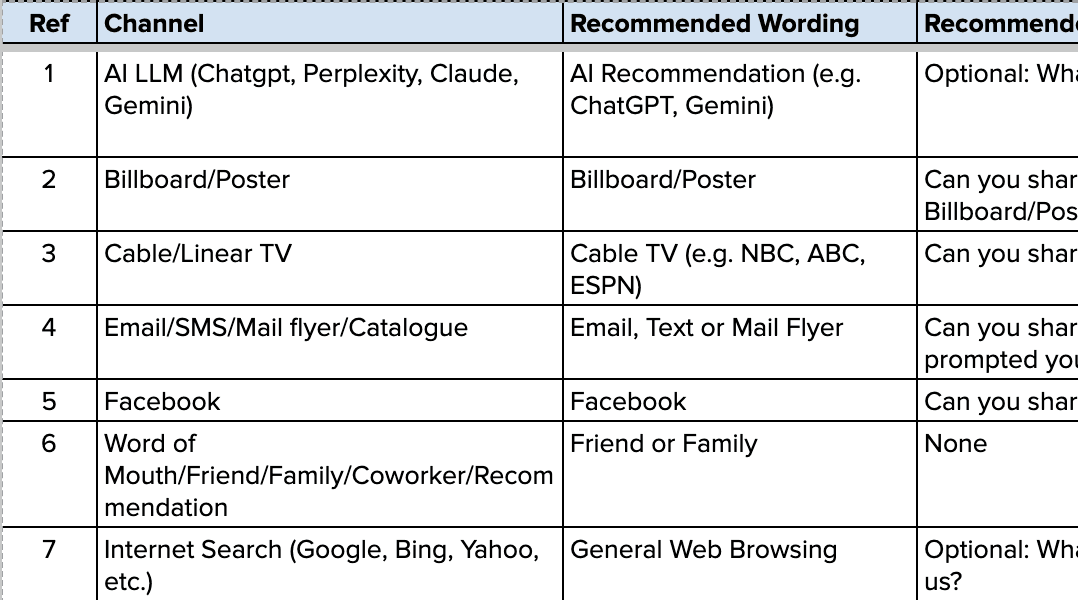

Recommended Answer Options
Only include options for channels you’re advertising on now or plan to soon. Use the wording in bold, and add the follow-up when you need the specific source.
Search
Search engine (e.g. Google). Optional follow-up: “What did you search to find us?” (open text). Run it periodically. It gets fewer responses, but it tells you which keywords to buy.
Social Media
List only the platforms you run.
Instagram. Follow-up: “Where on Instagram?” An ad, a post from [Brand], or a creator or influencer (“Which one?”, with auto-suggest).
Facebook. Follow-up: “Where on Facebook?” An ad, a post from [Brand], or a creator or influencer (“Which one?”, with auto-suggest).
TikTok. Follow-up: “Where on TikTok?” An ad, a post from [Brand], TikTok Shop, or a creator or influencer (“Which one?”, with auto-suggest).
YouTube. Follow-up: “Where on YouTube?” A YouTube ad, a video from [Brand], or a YouTube channel, creator or influencer (“Which one?”, with auto-suggest).
Pinterest. Follow-up: “Where on Pinterest?” A promoted Pin, a Pin from someone I follow, a Pin I searched for.
Reddit. Follow-up: “Which subreddit?” (open text).
Snapchat. Follow-up: “Where on Snapchat?” Snap ad, Discover feed.
Twitter/X. Follow-up: “Where on Twitter/X?” Twitter/X ad, a post from someone I follow.
Podcasts
Podcast. Follow-up: “Which podcast?” Use auto-suggest, pre-filled with the shows you advertise on.
TV, Streaming and Audio
TV (cable or streaming). Follow-up: “Which channel or app?” Use auto-suggest, pre-filled with what you buy.
Radio or streaming audio. Follow-up: “Which station or app?” Use auto-suggest.
Influencers and Creators
Influencer. Follow-up: “Which influencer?” Use auto-suggest, pre-filled with the creators and influencers you work with. If you use the platform-level influencer follow-ups above, keep this option for influencers you work with off-platform.
Word of Mouth
Friend or Family. No follow-up needed.
Received as a Gift. No follow-up needed.
Previous Customer. No follow-up needed. On a new-customer survey this is rarely needed. See “Ask two questions” below to ask returning buyers a separate question.
AI Assistants
AI recommendation (e.g. ChatGPT). Optional follow-up: “What did you ask to find us?” (open text). Run it periodically to see which questions bring buyers to you.
Retail, Events and Out-of-Home
In-Store. Follow-up: “Which store?” The locations that carry your product.
In-Person Event. Follow-up: “Which event?” Events you’ve run in the last 6 months.
Billboard/Poster. Follow-up: “Where did you see it?” Your billboard and poster locations.
Other Owned and Earned Channels
Email, Text or Mail Flyer. Follow-up: “Which one?” Email, text message, physical mail (flyer, postcard or catalog). Repeat buyers see “An email from [Brand]” and “A text from [Brand]” in their own list (see below).
Online Article/Blog. Follow-up: “Which publication?” Publications that have covered you.
Referral Site. Follow-up: “Which website or app?” Your affiliate partners.
Other
Other (please specify). Open text. Keep it as the last option and review the answers every month.
How to Use Follow-Up Questions
Fixed options first, specifics second. The first question is a single choice from short, fixed options, which keeps response rates high. Get the specific show, creator or platform in a follow-up, not by making the first question open text. Open-ended questions have lower response rates.
Use auto-suggest when the list of possible answers is long. For podcasts, influencers and TV networks, auto-suggest shows names as the buyer types. That gives clean, show-level data without a huge dropdown. As Mando put it: “We only get so far with ‘podcast’ as a response. Auto suggest has been huge, it gives us show-level insights we just couldn’t get before.”
Split vague labels with a follow-up rather than adding more top-level options. “Instagram” could mean paid, organic or influencer. Top-level choices are fine, but use follow-ups to clarify.
Watch your Other rate. If more than 10% of responses fall under “Other,” your answer options need refinement.
Let Fairing do the follow-ups. Advanced Attribution uses an adaptive follow-up to resolve the channel, the format and the exact source for every order.
Want the full channel list with question types? Download the full wording guide (Google Sheet).
Ask two questions: one for new customers, one for returning
A first-time buyer and a repeat buyer are answering different questions, so ask them different ones. Serving one list to both is how “email” ends up looking like a top-of-funnel channel when it is a lower-funnel channel.
Target each question by transaction count. Transaction count = 1 shows the new-customer question (“How did you hear about us?”, the list above). Transaction count above 1 shows the returning-customer question below.
What led you to [Brand] today? ([Brand] is your store’s own name, written out.)
An email from [Brand]
A text from [Brand]
I just needed more
I saw an ad. Follow-up: “Where?”
Saw a post from [Brand] on social media
A new product or restock
Someone recommended it again
Other (please specify). Follow-up: “Tell us more”
Survey setup rules
Use a single response question. We do not recommend Multiple Response for attribution questions: it adds a variable you cannot allocate to one channel.
Make each social platform its own option. Let the follow-up sort ad from brand post from creator or influencer. Never lead with “Social media ad”: it asks the customer to classify the placement, which is the part they get wrong.
Randomize the order and pin “Other” to the bottom. Fairing does this by default. In a fixed-order list the top option absorbs a lift it did not earn, and the whole dataset inherits the skew. See how well randomization corrects for it.
Option count matters less than people assume. The only caveat to adding more options is a larger margin of error when you extrapolate results. Details on how option count affects completion and extrapolating results.
Ask immediately after purchase, on the order confirmation page or in an onboarding flow, to every customer. Recency bias is real.
Fairing is a how did you hear about us survey tool for Shopify that asks both questions, randomizes the order and ties each answer to its order. On the Advanced Attribution plan, your options stay synced with your media partners or a Google Sheet, and typed-in answers that match your list are recategorized automatically.
Want this set up for you? Start free or Book a demo.
FAQ
How many answer options should a “How did you hear about us?” question have?
Only as many as you need to cover the channels you’re spending on now or plan to soon. Across Fairing surveys, the number of options has almost no relationship to completion rate, and randomization keeps any one option from sitting at the bottom for everyone. The one cost of a longer list is a larger margin of error when extrapolating results. If more than 10% of answers land in Other, add or reword options.
Should “How did you hear about us?” be multiple choice or open text?
Make the first question single choice with fixed options, then ask follow-ups. Open-text first questions get fewer responses and messier data. When Smalls moved from its in-house dropdown to Fairing’s optimized survey design, response rates rose to 90%, up from 50–60%. Use a Single Response question type: it keeps every order tied to one answer.
How do I add ChatGPT and other AI assistants as an option?
Add “AI recommendation (e.g. ChatGPT).” Fairing analyzed more than 80 thousand write-in answers and found that buyers describe AI tools as recommenders, so this wording matches how they think about it (see why this wording works). Fairing’s data showed more than a 5x increase in LLM mentions between January and June 2025. As of the Nov 2026 update, shoppers who said an AI tool led them to buy made up 4.8% of revenue across 200+ brands, 9.2 times what click tracking credits to AI. See the live AI sales benchmarks.
Should I include an “Other” option?
Yes, as the last option, with a text box. Review the write-ins every month. They show you new channels and wording to add. Mando reclassified its “Other” responses, cut them by 3.12%, and improved its podcast CPA by 9.7%.
When should I ask “How did you hear about us?”
Right after purchase, on the order confirmation page or in an onboarding flow, to every customer. In-moment surveys get response rates 10 times higher than delayed email or SMS surveys. Avoid email or SMS follow-ups sent more than 24 hours after purchase because of recency bias. Recency bias is real, so ask as close to the transaction as possible.
Should I list “Instagram ad” and “Instagram influencer” as separate options?
Usually not. Keep one “Instagram” option and ask a follow-up: Instagram ad, our Instagram account, or an Instagram creator. This keeps the first list short and still separates paid from organic.
Related: What is self-reported attribution? · HDYHAU survey best practices